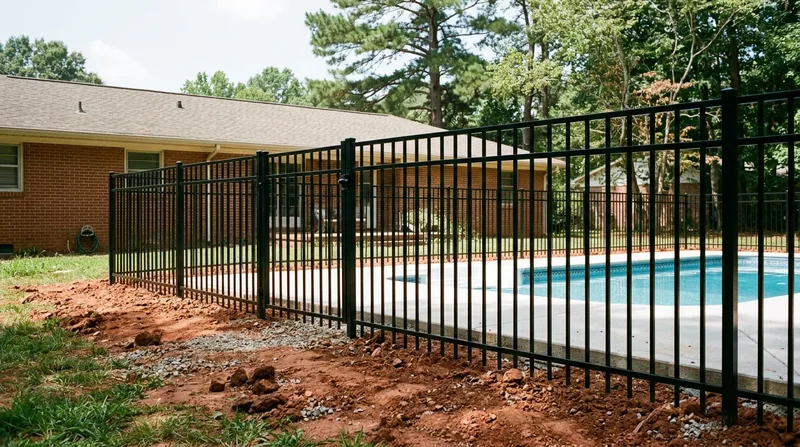




A pool fence installation in Durham protects your family and meets North Carolina safety codes, but it has to anchor past the red clay's saturation point or posts will fail within a few years. Durham's Piedmont terrain sits on heavy clay that holds water after rain, making post depth and concrete placement critical to longevity. Whether you're building a new barrier around an in-ground or above-ground pool, or replacing a fence that's sagging or rotted at the ground line, we install posts below the water table, size gates to swing away from the water, and latch them high to meet code. We've been installing fences across Durham, Chapel Hill, Cary, and the surrounding Piedmont since 2016, and pool barrier work carries the same precision we apply to every job: right material, correct depth, and a gate that works every time.
Why Pool Safety Fencing Matters in Durham's Climate and Code
Durham homeowners install pool safety fencing for two reasons: state law requires it, and the local climate punishes shortcuts. North Carolina pool barrier code sets minimum height, gate latching, and spacing rules that vary slightly by jurisdiction, but the real enemy is moisture. Our clay soils drain slowly, and winter ice heaves marginal posts, while spring and summer thunderstorms saturate the ground for weeks. A post set in tamped earth alone will rot at the ground line within five to seven years; concrete set below the clay's wet zone holds for decades.
- Pool barrier height and spacing are set by local code and must be verified with the Durham building department before installation.
- Gate latches must close and latch automatically, and the latch must be positioned high enough that a small child cannot reach it.
- Posts must be set deep and in concrete to resist frost heave and the constant moisture of our clay soil.
- A removable pool fence or mesh option can work for above-ground pools where code permits, reducing cost and allowing seasonal removal.
Code compliance is not our call to make, but we install to meet the barrier standards that apply at your address, and the local authority having jurisdiction makes the final determination. Call the Durham building department or your county's planning office to confirm the exact requirements for your property before we estimate.
Key info: North Carolina law requires a licensed land surveyor to determine a property line, but we work from your existing survey or the line you identify and install the fence where you direct us. If you're unsure of the exact boundary, a surveyor can mark it before we begin.
For detailed code requirements and permit information, visit the City of Durham Development Services website or contact your county planning department for setback, height, and material rules that apply to your zone.
How We Install Pool Fencing in Durham: Step-by-Step Process
Every pool fence we install starts with the same discipline: locate utilities, set posts below the clay's saturation line, and build a gate that swings away from the water and latches high. We use aluminum pool fencing for corrosion resistance in wet environments, or vinyl and wood where code and homeowner preference allow. Our crews have done this work long enough to know that a fence that looks right but fails to latch or sags after a year costs more to fix than it costs to build right the first time.
- We call 811 for a free utility locate to mark all underground lines before we dig any post holes.
- Posts are set in concrete below the clay's water table, typically 3 to 4 feet deep depending on soil conditions and frost line.
- We size the gate opening and hang the gate so it swings away from the pool and latches automatically at the top.
- All hardware is stainless steel or powder-coated to resist rust in the damp Piedmont climate.
- Final inspection confirms gate operation, latch height, and spacing compliance before we leave the site.
The entire process typically takes one to two days for a standard residential pool, depending on the fence length and soil conditions. We handle permits and code coordination as part of the estimate process, so you know before we start whether a permit is required at your address.
Local example: A Chapel Hill homeowner with a 40-foot pool perimeter and heavy red clay chose a vinyl fence with aluminum posts and self-closing hardware. We set posts 4 feet deep in concrete, hung a single gate at the deep end, and completed the work in one day. The fence passed inspection on the first visit and required no adjustments.
For more detail on our approach to gate installation and the hardware options we use, see our gate installation and repair page.
Pool Fence Material Options: Aluminum, Vinyl, and Wood
The material you choose affects cost, maintenance, and how long the fence will last in Durham's wet climate. Aluminum pool fencing resists rust and requires no painting, making it the lowest-maintenance choice for pool environments. Vinyl and wood are also code-compliant but demand more attention to moisture and rot prevention at the ground line.
| Material | Description | Best for Pool Barrier |
|---|---|---|
| Aluminum | Powder-coated aluminum posts and rails resist rust and require no staining or sealing. Lightweight and strong. | Wet environments where corrosion resistance and low maintenance are priorities. Works with vinyl infill panels. |
| Vinyl | PVC panels and posts do not rot, splinter, or require paint. Stable in wet conditions. More expensive than wood. | Homeowners who prioritize durability and zero maintenance. Works well in high-moisture areas like pools and coastal zones. |
| Pressure-Treated Wood | Treated pine resists decay better than cedar but will eventually rot at the ground line if posts are not set deep in concrete. | Budget-conscious installations where posts are set correctly below the water table. Requires periodic staining. |
| Mesh Pool Fence | Removable mesh panels on aluminum frames. Lightweight and seasonal. Code-approved for above-ground pools in most jurisdictions. | Above-ground pools and homeowners who want to remove the fence seasonally. Lower cost than permanent barriers. |
Regardless of material, the critical factor is post depth and concrete setting. A self closing pool gate hung on a well-set post will function for 20 years or more. A gate on a shallow post in tamped earth will sag, latch poorly, and need replacement within five years.
Pool Fence Installation Cost in Durham: What to Expect
Pool fence installation cost in Durham starts at $36 per linear foot for a basic aluminum or vinyl barrier with standard gate hardware, but the real cost depends on soil conditions, gate complexity, and whether code permits a mesh pool fence or requires a permanent structure. A 40-foot pool perimeter in good soil with one gate runs roughly $1,400 to $1,800 before permits. If your lot has heavy clay, sloped terrain, or requires deeper post setting due to high water table, add 15 to 25 percent. A second gate, decorative hardware, or reinforced framing for wind resistance adds $200 to $400 per feature.
The fastest way to understand what your pool fence will cost is to get two or three estimates from local installers who have seen your soil and property. We offer free estimates with a response within 24 hours at (984) 380-1829, and we'll walk you through what drives the price before we submit a number. For a detailed pricing breakdown and examples of how different materials and options affect cost, see our full pricing overview.
Permits, if required, typically cost $50 to $150 and take one to two weeks to obtain. We coordinate this with the city and include the cost in our estimate so there are no surprises.
Pool Fence Installation Near Me: What Durham Homeowners Should Know Before Hiring
Hiring the right fence installer matters more than choosing the cheapest quote. A pool fence is a safety barrier and a code requirement, so the person who builds it needs to understand local regulations, soil conditions, and gate mechanics. Before you call, ask yourself these questions: Does the installer know Durham's clay soil and frost heave? Can they explain why post depth matters? Do they carry general liability and workers' compensation insurance? Will they coordinate with the building department, or will you?
North Carolina has no statewide fencing license, but projects at or above $40,000 require a licensed general contractor. Most residential pool fences fall below that threshold, so licensing is not the primary credential to check. What matters is insurance, references, and experience with your specific material and local code. We are fully insured and can provide a certificate of insurance on request. We've been installing fences in Durham since 2016, and we're an AFA Member Installer with the American Fence Association, which means we follow professional installation standards and ethics.
- Get at least two estimates and ask each installer why their price is what it is, not just what it is.
- Check references from recent pool fence jobs in your neighborhood or similar soil conditions.
- Ask whether the installer will call 811 for utility locates and handle permit coordination.
- Confirm that the installer understands your local code and will install to meet it, not certify it.
- Make sure the contract specifies post depth, concrete volume, gate hardware, and completion timeline.
If you're ready to move forward, contact us for a free estimate. We'll visit your property, assess soil and slope, confirm code requirements with the building department, and give you a clear price and timeline before we start work.
Pool Fence Installation in Durham: Pricing Guide
| Service | Price | Details |
|---|---|---|
| Aluminum pool fence, standard gate | Starting at $36/ft | Aluminum posts and vinyl infill, one self-closing gate, stainless hardware. Typical 40-foot pool runs $1,400 to $1,800 |
| Vinyl pool fence, reinforced frame | Starting at $42/ft | PVC posts and panels, aluminum reinforcement, one automatic gate, full hardware. Premium durability, zero maintenance required |
| Mesh removable pool fence | Starting at $28/ft | Aluminum frame with mesh panels, removable design for above-ground pools, seasonal installation and removal available |
| Additional gates or features | $200 to $400 each | Second gate, wind bracing, decorative hardware, or sloped terrain installation adds cost beyond base linear footage |
| Difficult soil or deep water table | Add 15 to 25 percent | Heavy clay, poor drainage, or high water table may require deeper post setting or additional concrete reinforcement |
| Free estimate and 24-hour response | No obligation | We visit your property, assess soil and code, and provide a detailed written estimate with no charge to review |
Indicative pricing, the exact cost depends on square footage, finish, and site access. Free personalized estimate within 24h at (984) 380-1829.


