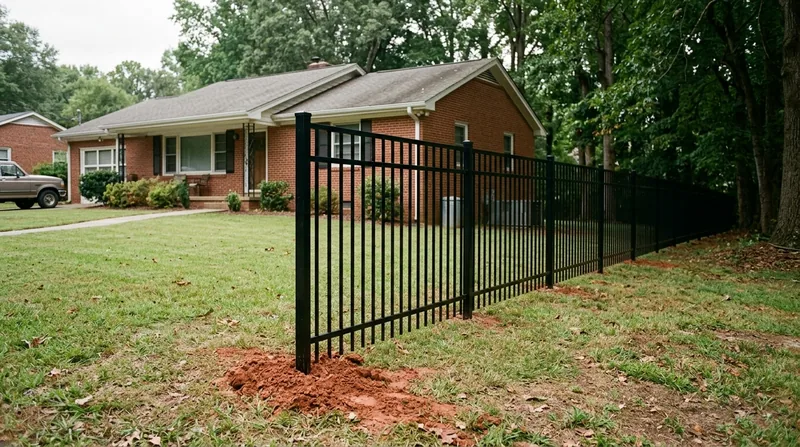




Durham's Piedmont terrain and humid climate create ideal conditions for aluminum fence installation, where rot and rust are constant threats to wood and untreated steel. An aluminum or ornamental iron fence holds its line on sloped lots without the ground-line decay that claims wood posts in this red clay soil within five to seven years. We anchor posts below the saturation point so panels stay straight through soggy winters, and the material resists the moisture that makes fence maintenance a losing battle in this region. Whether you're securing a property line in established neighborhoods like Old North Durham or protecting a newer subdivision lot in Chapel Hill, an aluminum or ornamental iron fence delivers clean lines and decades of service without annual staining or seal coats. This page covers why these materials work here, how we install them on Durham's challenging slopes, what to budget, and how to hire the right fence contractor for the job.
Why Aluminum and Ornamental Iron Fencing Make Sense in Durham's Climate
Durham sits in the Piedmont where spring and early summer rains saturate clay soil, and summer thunderstorms plus the inland remnants of Atlantic hurricanes test fence integrity from June through November. Wood posts set in this wet clay fail at the ground line in less than a decade, even pressure-treated pine, because the clay holds water against the wood grain and rot starts below sight. Aluminum posts never rot. Ornamental iron, when properly galvanized or powder-coated, resists rust far longer than bare steel, and the weight of cast or wrought iron panels keeps them straight on the sloped lots common across Durham, Chapel Hill, and Cary. Homeowners who choose these materials trade the lower upfront cost of chain link or wood for a fence that survives 20 to 30 years with no restaining, no seal coats, and no post replacement.
- Aluminum posts will not rot at the ground line, even after decades in Durham's wet Piedmont clay.
- Galvanized and powder-coated ornamental iron resists rust and holds color through salt spray and acid rain.
- Both materials stay straight on sloped terrain without the sag that plagues wood rails over time.
- Aluminum and ornamental iron require no annual maintenance, staining, sealing, or post replacement.
- These materials work in HOA-governed subdivisions where wood grain or vinyl appearance may not meet architectural standards.
The upfront investment is higher, but the absence of rot repair, post replacement, and refinishing work makes aluminum and ornamental iron the lower total-cost choice over 20 years.
Key info: In Durham's humid Piedmont, a wood fence post typically lasts 5 to 7 years before rot claims the ground line. An aluminum or ornamental iron fence eliminates that cycle, making it the practical choice for homeowners planning to stay in place. A property in Cary or Chapel Hill governed by HOA rules often requires ornamental iron or aluminum to match architectural standards that exclude wood or vinyl.
For more on how materials compare, see our guides to wood and privacy fence installation and vinyl and PVC fence installation.
How We Install Aluminum and Ornamental Iron Fencing on Durham's Sloped Terrain
Durham lots slope, often steeply, which means the fence must either be racked (panels angled to follow the slope) or stepped (panels level with grade drops between sections). Ornamental iron panels are too heavy and rigid for racking; they must be stepped or installed on level ground. Aluminum panels, lighter and more forgiving, can be racked on moderate slopes if the design permits. We start every job with a site walk to identify the slope, check for utility lines (required by North Carolina 811 law before digging), and confirm the fence line with the customer. Posts go in below the clay's saturation point, set in concrete rather than tamped, so they stay plumb through winter freeze-thaw cycles and spring wet seasons.
- We call 811 before digging any post hole to locate buried utilities and avoid costly damage.
- Posts are set in concrete below the water table on sloped lots to prevent frost heave and settling.
- On steep slopes, we step the panels rather than rack them, keeping each section level and maintaining consistent picket or spindle spacing.
- Ornamental iron panels are braced and anchored to resist wind load and the weight of the material itself.
- Post spacing is set to match panel width, typically 5 or 6 feet, so rails and spindles align without cutting or shimming.
The result is a fence that sits plumb and level on uneven ground, with no twisting, sagging, or misaligned panels even after heavy rain and frost.
Example: A lot in Morrisville with a 6-degree slope running the length of the property calls for stepped installation. We set posts at grade, then drop the panel height by 6 to 8 inches at each step, keeping the top rail level within each section. Ornamental iron panels handle this cleanly because the stepped design is visible and intentional, not a workaround for sagging panels.
Learn more about fence post repair and replacement when existing posts fail on sloped terrain.
Aluminum vs. Ornamental Iron: Which Material Is Right for Your Durham Property
Aluminum and ornamental iron are both durable, but they serve different purposes and price points. Aluminum is lighter, easier to install, and costs less upfront, making it popular for residential properties where a clean, modern look is the goal. Ornamental iron, including wrought iron and cast iron panels, is heavier, more formal in appearance, and better suited to properties where architectural presence and traditional aesthetics matter. Ornamental iron also holds up better to wind load and impact because of its mass and rigidity. In Durham, where HOA architectural guidelines often govern fence material and style, ornamental iron is frequently the preferred choice for established neighborhoods and master-planned communities.
| Material | Key Characteristics | Best For |
|---|---|---|
| Aluminum | Lightweight, rust-proof, requires no coating, available in white or powder-coated colors, panels can be racked on moderate slopes. | Residential properties seeking a clean modern look, sloped terrain, budget-conscious homeowners, coastal or high-moisture areas. |
| Ornamental Iron (Wrought or Cast) | Heavy, formal appearance, requires galvanizing or powder coating, resists wind load and impact, panels must be stepped on slopes, higher upfront cost. | Historic neighborhoods, HOA-governed communities, properties where architectural presence is a priority, formal or traditional home styles. |
| Aluminum with Ornamental Details | Aluminum extrusions mimicking ornamental iron spear tops or scrollwork, lighter than true iron, lower cost, same rust resistance. | Homeowners wanting ornamental appearance without the weight, sloped lots, HOA properties where aluminum is approved as an alternative. |
| Steel Fence (Industrial or Custom) | Bare steel requires regular coating, galvanized steel resists rust, heavier than aluminum, custom fabrication available, can be powder-coated any color. | Commercial properties, farm and ranch fencing, custom architectural designs, properties where budget allows for coating maintenance. |
The choice between aluminum and ornamental iron often comes down to aesthetic preference and HOA requirements. Aluminum is the practical choice for most residential properties; ornamental iron earns its higher cost when the visual impact and formal character are worth the investment.
Aluminum and Ornamental Iron Fencing Cost in Durham: What to Expect
Aluminum fence installation in Durham typically starts at $44 per linear foot for basic residential panels, and ornamental iron runs from $60 to $120 per linear foot depending on panel design, height, and finish. A 100-foot aluminum fence costs roughly $4,400 to $5,500 installed; a 100-foot ornamental iron fence ranges from $6,000 to $12,000. The total cost depends on the slope of your lot, whether posts must be set in concrete below the water table, gate openings, post spacing, and finish options like powder coating color. A steeply sloped property that requires stepped installation may cost more because each step is labor-intensive and may require custom panel heights. Aluminum panels on a level lot with simple installation run closer to the lower end; ornamental iron with custom scrollwork or spear tops, plus powder coating in a non-standard color, moves toward the higher range.
We recommend getting 2 to 3 estimates so you understand what's included at each price point. Some contractors quote per linear foot without accounting for slope, concrete, or gate openings; others include everything. Our estimate is free and comes with a site walk so you know exactly what the job entails before you commit. Call us at (984) 380-1829 or visit our pricing page for a detailed breakdown of material and labor costs by fence type.
Factors that move the price up include steep slopes requiring stepped installation, difficult access for equipment, post holes in rock or clay that requires hand digging, custom gate openings, and ornamental panels with intricate scrollwork. Factors that keep it lower include level terrain, easy access, standard panel heights, and simple aluminum designs. Winter installation (December through February) sometimes offers discounts because demand is lower, though frozen or water-logged ground can slow the work. Spring and early summer are peak season, and prices reflect it.
Aluminum and Ornamental Iron Fencing Near Me: What Durham Homeowners Should Know When Hiring
Hiring the right fence contractor matters more than price alone. In North Carolina, fence installation below $40,000 does not require a state general contractor license, but projects at or above that threshold do require a licensed general contractor. We are fully insured with general liability and workers' compensation coverage, and we provide a certificate of insurance on request. We have been in business since 2016 and hold membership in the American Fence Association as an AFA Member Installer, which means we follow industry standards for material, labor, and safety. When you call for an estimate, ask for references from recent jobs in your neighborhood, check that the contractor carries workers' compensation insurance (not just general liability), and verify that they understand local permit requirements and HOA architectural standards in your community.
- Request a certificate of insurance showing general liability and workers' compensation coverage before work begins.
- Ask for references from at least two recent jobs in Durham, Chapel Hill, or Cary, and call them to ask about the fence quality and how the contractor handled problems.
- Confirm that the contractor understands your HOA's architectural standards if your property is in a master-planned community.
- Verify that the contractor will call 811 before digging and will obtain any required city or county permits on your behalf.
- Get the estimate in writing with a breakdown of material, labor, post concrete, and any gate openings so you know what you are paying for.
A good contractor will ask you questions about your property line, utility locations, and slope before quoting a price. If a contractor gives you a number over the phone without a site visit, that estimate is guesswork. We walk every property and provide a detailed, honest estimate within 24 hours. Contact us at our contact page or call (984) 380-1829 to schedule your free estimate.
Aluminum & Ornamental Iron Fencing in Durham: Pricing Guide
| Service | Price | Details |
|---|---|---|
| Aluminum fence installation | Starting at $44/ft | Residential aluminum panels on level or gently sloped terrain, posts set in concrete, standard colors |
| Ornamental iron fence installation | Starting at $60/ft | Wrought or cast iron panels, galvanized or powder-coated finish, stepped on sloped terrain, formal designs |
| Stepped installation on slopes | Starting at $65/ft | Aluminum or ornamental iron panels stepped to follow grade, additional labor for custom panel heights and transitions |
| Gate openings and custom details | On estimate | Gate openings, spear tops, scrollwork, and non-standard colors require site measurement and custom fabrication |
| Travel and estimate | Free estimate; included travel | No charge for the site walk and written estimate, free travel within Durham and surrounding service areas |
Indicative pricing, the exact cost depends on square footage, finish, and site access. Free personalized estimate within 24h at (984) 380-1829.


