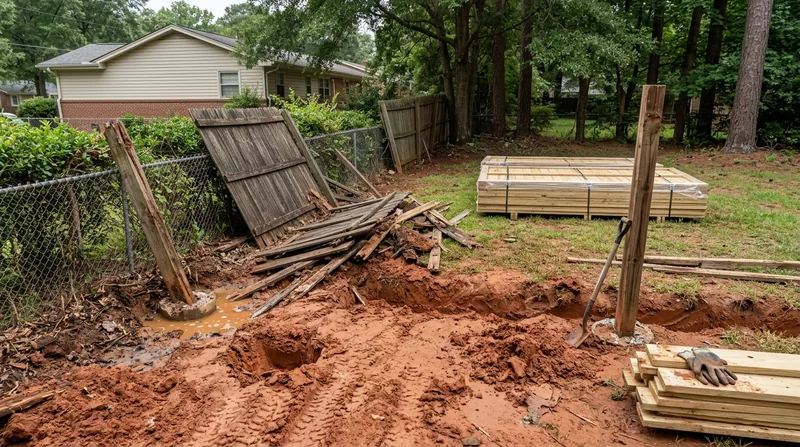




A fence replacement in Durham means pulling posts that have sat in red clay and wet ground for years, hauling off the old material, and setting new posts on proper drainage before the next line goes up. The Piedmont's heavy clay and seasonal water retention take a toll on wood and metal alike, especially where posts meet soil. Whether you're replacing a sagging wood fence, rusted chain link, or storm-damaged sections, the ground conditions here make the difference between a job that holds and one that fails within five years. We handle the full scope: removal, grading, new post setting, and installation of wood, vinyl, chain link, or ornamental metal fencing. This page covers why replacement makes sense when repair won't, how the process works in Durham's terrain, and what to expect in cost and timeline.
Why Fence Replacement and Removal Matters in Durham's Climate and Soil
Durham's red clay holds water after heavy rain, and that moisture sits at the base of fence posts for weeks. Untreated wood rots at the ground line; galvanized posts rust from the inside out; concrete footings crack and heave in freeze-thaw cycles. A fence that might last 15 to 20 years in drier regions often fails in 8 to 12 years here. When posts shift, rails sag, pickets warp, or chain link mesh tears, repair alone cannot fix the root cause: posts that were never set to handle this climate in the first place.
- Rotted posts at the ground line cannot be repaired and must be replaced to stop the collapse of the entire section.
- Posts set in tamped soil without concrete drainage fail faster than those set in concrete with proper slope and gravel base.
- Sloped lots common in Durham require racked or stepped installation to follow grade and prevent water pooling at low points.
- Old fences installed before modern post-setting standards often need full replacement rather than selective repair to regain structural integrity.
- Storm damage from summer thunderstorms and Atlantic hurricane remnants frequently triggers replacement of multiple sections at once.
Replacement is the right choice when the fence line has more failed posts than sound ones, when the cost of multiple repairs approaches the cost of a new fence, or when the original installation does not suit Durham's drainage and climate. We assess every fence before recommending replacement, because repair is always the better spend when it will hold.
Key info: Durham and surrounding areas require a North Carolina 811 utility locate before any digging for post holes. This is free, takes 2 to 3 business days, and is the law. We call it in before we start. Check the city or county building department website for permit requirements in your neighborhood, as they vary across the Greater Durham area.
For more on when repair alone makes sense, see our fence repair page.
How Fence Replacement and Removal Works: Our Process in Durham
Replacement in Durham starts with removal. We pull posts, cut and haul old wood or chain link, and grade the fence line. The next step is the critical one: we set new posts in concrete with proper drainage. Posts sit in a hole dug to frost depth (typically 2.5 to 3 feet here), set plumb, braced, and surrounded by concrete with the top sloped to shed water away from the post. Gravel at the base of the hole prevents water from pooling at the post foot. Only after posts are cured do we hang rails, add pickets or mesh, and finish with cap and trim.
- We call in a North Carolina 811 utility locate to mark gas, electric, water, and communications lines before digging any post holes.
- Old fence material is cut into manageable lengths, loaded, and hauled to a licensed disposal facility or recycling center.
- The fence line is graded level or sloped to match the lot, and we mark post locations at standard spacing (typically 6 feet on center for residential fencing).
- New posts are set in concrete with the top of the footing sloped away from the post to prevent water from collecting and rotting the wood or rusting the metal.
- Rails are installed level (not following the slope of the ground) and fastened with corrosion-resistant hardware; pickets or mesh are then hung and secured.
The entire process takes 3 to 7 business days depending on fence length, site access, and whether the ground is frozen or saturated. In spring and early summer, scheduling is tighter because this is peak installation season across the region.
Local example: A 200-linear-foot privacy fence replacement on a sloped lot in Chapel Hill took 5 days: one day to remove the old fence and grade, two days to set posts and allow concrete to cure, and two days to install rails and pickets with board-on-board overlap to follow the slope. The homeowner chose pressure-treated pine with a stain finish to match the neighborhood aesthetic and extend the wood life in Durham's humid climate.
For details on fence post repair and replacement, see our dedicated page.
Fence Replacement Methods and Material Options
| Approach | Description | Best for |
|---|---|---|
| Full line replacement | Remove entire fence, set all new posts, install new rails and pickets or mesh in a single material and style. | Fences older than 10 years, or where most posts have failed and repair cost approaches replacement cost. |
| Sectional replacement | Remove and replace only the failed sections, leaving sound posts and sections intact; new and old material must be compatible in height and style. | Fences with localized storm damage, or where only 20 to 40 percent of the line has failed. |
| Material upgrade | Remove old wood or chain link and replace with vinyl, pressure-treated pine, cedar, or ornamental metal; new posts are set to modern drainage standards. | Homeowners who want lower maintenance (vinyl), longer life (cedar or pressure-treated), or a style change (ornamental iron or aluminum). |
| Racked vs. stepped installation | Racked fencing follows the slope of the ground; stepped fencing uses horizontal rails and creates a stair-step profile at sloped sections. | Sloped lots in Durham. Racked is more aesthetic on gentle slopes; stepped is required by many HOAs and works better on steep grades. |
Fence Replacement and Removal Cost in Durham: What to Expect
Fence replacement in Durham starts at around $2,500 for a 150-linear-foot vinyl or pressure-treated wood privacy fence with new posts set in concrete. The cost per linear foot typically ranges from $15 to $45 depending on material, height, site access, and whether the old fence is still standing or already down. Removal adds $500 to $1,500 to the project depending on fence length and what must be hauled away. Chain link replacement runs lower per linear foot; ornamental metal and cedar run higher. Sloped lots in Durham often require stepped or racked installation, which adds labor but ensures the fence will not trap water or fail prematurely.
Several factors move the cost up or down. A fence on a steep slope takes longer to install because each section must be carefully measured and cut to follow grade. Posts set in hard clay cost more in labor than posts set in sandy soil. Storm damage that requires removal of fallen trees or debris near the fence line adds to the scope. Access matters too: if the fence line runs through a narrow side yard or around dense landscaping, equipment and crew movement slow the work. A fence that is already down and rotted costs less to remove than one that is standing and must be carefully dismantled to avoid damage to neighboring property.
The best way to know your cost is to get a free estimate. We can give you a ballpark number over the phone based on length and material, but a site visit is the only way to account for slope, soil, access, and whether any posts can be salvaged. See our full pricing page for more detail on what moves the cost and how we price different materials.
What to Look for When Hiring a Fence Replacement and Removal Contractor Near Me in Durham
Hiring the right contractor for fence replacement and removal in Durham means checking three things: insurance, references, and whether the contractor understands local permits and HOA rules. North Carolina has no state license for fence installation on projects under $40,000, so a state license is not a credential you should expect. What you should verify is that the contractor carries general liability and workers' compensation insurance and can provide a certificate of insurance on request. Ask for references from recent jobs in your neighborhood, and call them to ask whether the fence was installed to spec, whether posts were set in concrete, and whether the work held up through a winter and a summer.
Permits and deed restrictions vary across Greater Durham. Some areas require a permit for any fence; others do not. Most master-planned communities have HOA architectural standards that govern fence height, material, and color. We recommend checking your local city or county building department website and your HOA documents before you call an estimate. We do the same before we bid, and we will tell you up front if a permit is required or if your plan conflicts with an HOA rule. That honesty saves you money and headache.
Call us at (984) 380-1829 for a free estimate, or visit our contact page. We respond within 24 hours and can usually schedule a site visit within a few days. We have been in business since 2016 and are an AFA Member Installer with the American Fence Association, fully insured, and ready to handle your replacement or removal from start to finish.
Fence Replacement & Removal in Durham: Pricing Guide
| Service | Price | Details |
|---|---|---|
| Wood or vinyl privacy fence replacement | Starting at $2,500 | 150 linear feet, new posts set in concrete, pressure-treated pine or vinyl, standard 6-foot height, level ground |
| Chain link fence replacement | Starting at $1,800 | 150 linear feet, new posts and rails, galvanized or powder-coated steel, standard gauge and mesh, includes old fence removal |
| Ornamental metal or cedar fence replacement | Starting at $3,500 | 150 linear feet, new posts in concrete, cedar or aluminum with powder-coat finish, premium materials and craftsmanship |
| Sloped or stepped installation | Add 15 to 25 percent | Racked or stepped fencing on grades over 10 percent requires additional layout, cutting, and bracing labor |
| Fence removal and haul-off only | Starting at $500 | Old fence cut, loaded, and hauled; grading and new installation quoted separately based on site and material |
| Free estimate and site visit | No charge | Response within 24 hours at (984) 380-1829, no obligation to book, includes slope, soil, and access assessment |
Indicative pricing, the exact cost depends on square footage, finish, and site access. Free personalized estimate within 24h at (984) 380-1829.


